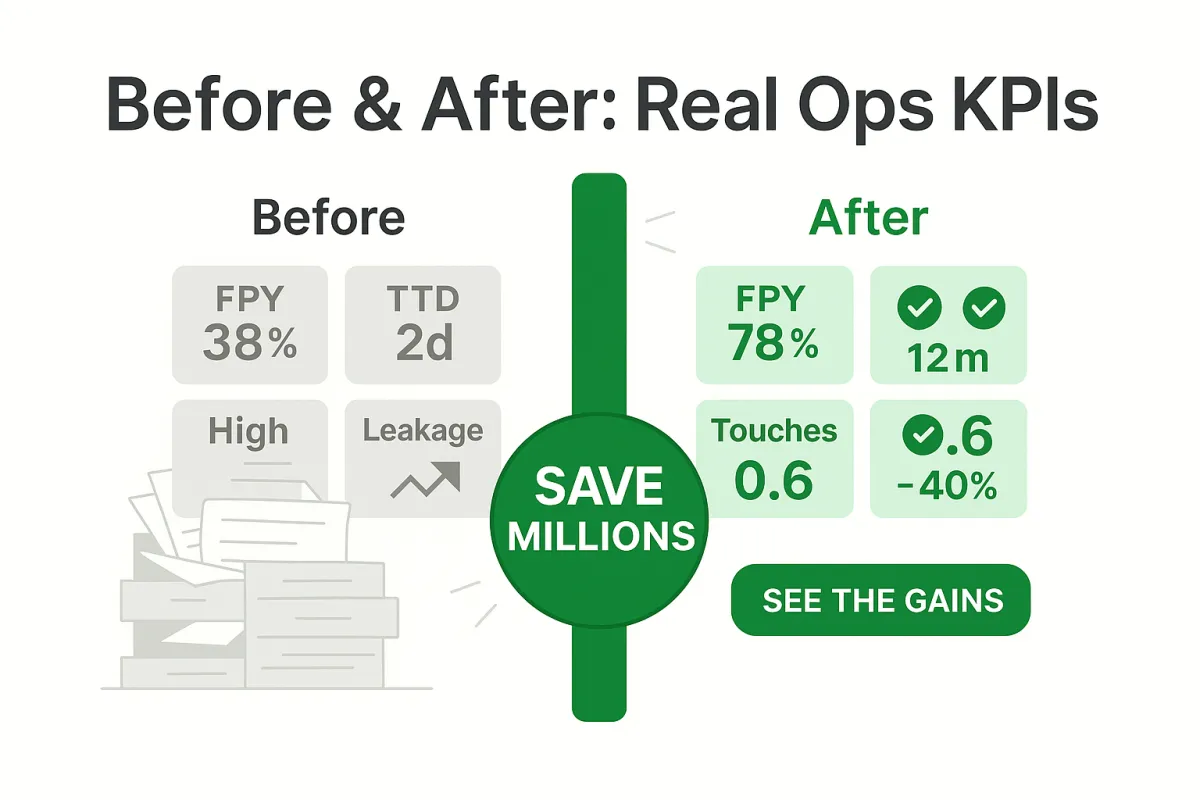
Before & After: Real Ops KPIs That Prove AI Scanning Saves Millions
Before & After: Real Ops KPIs That Prove AI Scanning Saves Millions
Operations don’t improve because a vendor says they will—they improve when the numbers move. If your onboarding, claims, or KYC/KYB flows still depend on people opening PDFs and eyeballing details, you’re paying for minutes, delays, and leakage you don’t need. This “before & after” guide shows the exact KPIs that change when you switch to AI document scanning and validation, and why those shifts translate directly into hard cash.
The KPI set that tells the whole story
1) First-Pass Pass Rate (FPY)
Before: Many files fail silently and bounce around inboxes.
After: AI classifies, extracts, and checks presence/type/legibility/expiry/cross-doc match instantly, so more submissions clear on the first attempt.
Target movement: +25–45 points (e.g., 38% → 72–83%).
2) Average Time-to-Decision (TTD)
Before: Hours or days waiting for someone to open attachments.
After: Minutes. Clean packets get an immediate “pass,” while fails return precise reason codes and a one-tap re-upload link.
Target movement: 1–3 days → 5–20 minutes.
3) Exception Closure Time (fail → fixed → pass)
Before: Back-and-forth emails; applicants respond when they remember.
After: Reason-coded messages + WhatsApp/email re-upload links compress fixes into the same session.
Target movement: 2–5 days → 30–180 minutes.
4) Touches per Case
Before: 2–6 touches just to assemble a usable packet.
After: “Exceptions-only” becomes normal; clean cases have zero human touches.
Target movement: 3.2 → 0.6 average touches.
5) Top Fail Reasons (distribution)
Before: Anecdotes and guesswork; you can’t improve what you can’t see.
After: Structured analytics (e.g., missing page 2, expired ID, name mismatch, unreadable photo) drive copy and form changes that raise FPY again next week.
6) Queue Aging
Before: Big tails (3–7 days).
After: Most items clear the <2-hour bucket; long tails become rare edge cases.
7) Dispute/Chargeback/Write-Off Rate tied to Intake
Before: Bad documents slip through; you pay later.
After: Expiry/mismatch/tamper checks block leakage at the door.
Target movement: −30–70% depending on line of business.
8) Storage Footprint per 1,000 Cases
Before: Keep everything “just in case.”
After: Retention by policy and redacted exports reduce risk and cost.
9) Time-to-Evidence (Audit Export)
Before: Days of reconstruction.
After: Reason-coded, time-stamped trails export in seconds.
10) Cost per Decision
Before: First-pass labor + rework loops dominate.
After: Automation removes first-pass labor; analysts work only exceptions.
A simple “millions” math you can check
Volume (V): 30,000 submissions/month
Manual minutes first pass (M): 8
Rework rate (R): 35% need a second touch
Minutes per rework (E): 6
Analyst cost (H): 300/hour (fully loaded)
Manual labor hours
First pass: 30,000×8/60=4,00030{,}000 \times 8/60 = 4{,}00030,000×8/60=4,000
Rework: 30,000×0.35×6/60=1,05030{,}000 \times 0.35 \times 6/60 = 1{,}05030,000×0.35×6/60=1,050
Total: 5,050 hours → 1,515,000 in labor/month
Now flip to AI scanning/validation where only 15% become exceptions and each exception takes 10 minutes:
30,000×0.15×10/60=75030{,}000 \times 0.15 \times 10/60 = 75030,000×0.15×10/60=750 hours → 225,000 in labor/month.
Labor delta: ≈ 1.29M saved per month — before counting higher conversion (faster TTD) and lower leakage (fewer bad approvals). That’s why the total impact often lands in the millions per quarter.
What creates those KPI jumps
Instant classification + extraction: IDs, passports, licences, statements, payslips, invoices recognized in seconds; key fields captured.
Objective validation: Presence, type, legibility, expiry, cross-document consistency, and tamper cues run every time—no drift.
Reason-coded outcomes: Applicants see exactly what to fix, with a secure re-upload link (WhatsApp/email).
Exceptions-only routing: Humans focus on judgment, not file-sorting.
Audit by design: Decisions are time-stamped with reason codes and actor IDs; exports are one-click.
The takeaway
You don’t have to believe a promise—watch the KPIs move. When FPY rises, TTD collapses, touches per case fall, and leakage drops, the P&L follows. That’s the “before & after” of AI document scanning and validation: faster approvals, lower cost, fewer disputes, and audit certainty that frees your team to win more business.
Homepage: https://aidocumentvalidator.com
Full FAQ: https://aidocumentvalidator.com/faq
